Organization of a banquet in Lviv
A good banquet is a balance between comfort, delicious cuisine, and ...

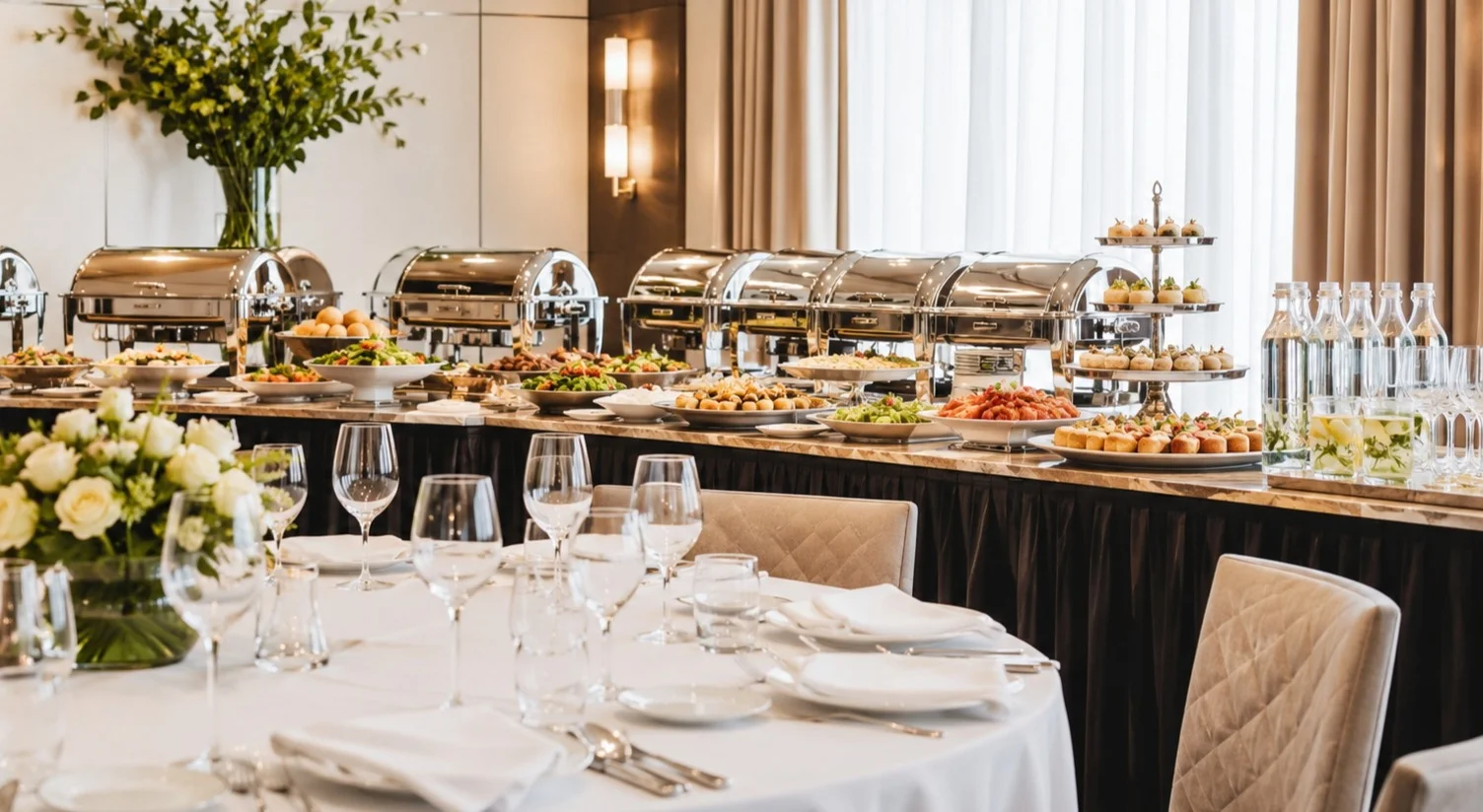
We'll walk you through step-by-step how to calculate a banquet menu per person: how much food and drinks you need, how to take into account the format and duration of the event, children, vegetarians, and supplies, as well as how to calculate a menu for 20, 50, or 100 guests.
STEP 1 — DEFINE THE FORMAT AND DURATION: HOW TO CALCULATE A BANQUET MENU FOR A COCKTAIL RECEPTION, CLASSIC BANQUET AND BUFFET
The first step is to clearly define the event format:
Cocktail reception or standing reception
Classic seated banquet
Buffet
A cocktail reception focuses more on appetisers and light portions, a buffet offers greater variety and self-service, while a classic banquet requires individually served hot dishes and more waiting staff.
The second parameter is the duration:
Short event — 2–3 hours
Medium-length event — 3–4 hours
Long event — 4–6+ hours
The longer the event lasts, the more food should be planned per guest.
The format and duration also determine staffing requirements and serving logistics.
A cocktail reception usually requires more standing tables and bar areas, while a classic banquet requires table arrangement and full table setting.
If necessary, LeOla Catering in Lviv can advise on the most suitable format for a particular event and estimate the required number of staff.
STEP 2 — BASIC FOOD WEIGHT GUIDELINES AND DISTRIBUTION BY CATEGORY: EXAMPLE OF CALCULATING A BANQUET MENU PER PERSON
Approximate total amounts of prepared food per guest:
Short event — 500–700 g
Medium-length event — 700–900 g
Long event — 900–1500 g
A percentage-based approach is useful for dividing the total amount of food:
Cold appetisers — 20–30%
Salads — 10–15%
Hot dishes — 40–50%
Dessert — 10–15%
Bread — 5–8%
Cold appetisers — 250 g
Salad — 120 g
Hot dishes — 450 g
Dessert — 120 g
Bread — 60 g
These proportions make it possible to adjust the menu according to the type of guests:
More appetisers for a cocktail reception
More hot dishes for a classic banquet
This approach also helps reduce unnecessary leftovers.
Soft drinks and water should be calculated separately.
Approximate guidelines:
Overall — 1–2 litres per guest depending on the weather and level of activity
In summer — approximately 1.5–2 litres
In winter — approximately 0.8–1.2 litres
Morning and daytime events may require more coffee and tea.
Evening events may require more non-alcoholic cocktails and soft drinks.
A 0.75-litre bottle of wine provides approximately 5 servings of 150 ml.
Formula:
Multiply the number of guests by the average number of glasses per guest.
Divide the result by 5.
The result is the approximate number of bottles of wine required.
Sparkling wine can be calculated in the same way as regular wine.
One glass is approximately 150 ml.
A serving of vodka or another spirit is approximately 30–40 ml.
A 0.75-litre bottle provides approximately 25 servings of 30 ml.
Formula:
Multiply the number of guests by the average number of servings per guest.
Divide the result by 25.
The result is the approximate number of bottles of spirits required.
Seasonal adjustments and the serving scenario, including toasts and bar service, can significantly affect these quantities.
For more complex events, a local consultation can help determine the required amount of drinks more accurately.
Children under approximately 12 years old are usually calculated as 0.4–0.6 of an adult portion depending on their age and the duration of the event.
For children’s parties with active games, the figure can be closer to 0.6.
For teenagers:
0.8–1.0 of an adult portion
A separate children’s menu can include:
Soft textures
Fewer spices
Individual meal boxes
For older guests, a coefficient of the following can be used:
0.7–0.9 of a standard adult portion
It is usually better to offer:
More light salads
Soups
Warm light dishes
Less heavy and fatty hot food
Determine in advance how many vegetarians and guests with dietary restrictions will attend.
The corresponding amount of meat can be replaced with protein alternatives:
Legumes
Mushrooms
Other plant-based protein options
Allow:
10–15% extra for unexpected guests or higher appetites
15–20% extra when the RSVP is uncertain
Round quantities to convenient portion sizes, serving trays or product packages to minimise leftovers.
Guideline:
600–700 g of food per person
Example distribution:
Cold appetisers — 150 g
Salad — 100 g
Hot dishes — 300 g
Dessert — 80 g
Bread — 30 g
For 50 guests without a reserve, this is approximately 30 kg in total.
With a 10% reserve, approximately 33 kg is required.
Drinks:
Water and soft drinks — approximately 1.2 litres per person
Guideline:
1–1.3 kg of food per person
For 20 guests:
20–26 kg of prepared food
For 100 guests:
100–130 kg of prepared food
For 100 guests, approximately 120–200 litres of water and soft drinks may be required depending on the season.
Wine and sparkling wine should be calculated separately using the serving formula.
LeOla has experience preparing customised calculation templates for events in Lviv and can help recalculate a menu for a specific number of guests.
For smaller celebrations, a venue with its own kitchen is often the more convenient option.
For larger events, professional off-site service or catering is usually more practical.
Approximate staffing guidelines:
Classic banquet — 1 waiter for every 8–12 guests
Buffet — 1 waiter for every 20–30 guests
Bartender — 1 for every 40–60 guests
Chef — 1 for every 30–50 guests depending on the menu and complexity
For large events, it is also advisable to include an event coordinator.
Calculate:
1 full set of tableware per guest
An additional 10% reserve for breakages and changes between dishes
For a cocktail reception, additional items may be required:
Standing tables
Serving trays
Disposable or reusable tableware
The logistics of washing and collecting tableware should be planned in advance.
To minimise losses:
Use accurate portioning
Arrange for suitable leftovers to be donated where possible
Prepare containers for takeaway food
When there is no kitchen at the venue, when the number of guests is large or when there are many dietary restrictions, it is usually better to order professional catering.
This reduces risks and the logistical burden on the organiser.
For events in Lviv, LeOla can advise on the balance between budget, staffing and the most suitable service format.
Approximate guidelines:
Short event of 2–3 hours — 500–700 g per person
Medium-length event — 700–900 g per person
Long event of 4–6+ hours — 900–1500 g per person
The format can change these figures.
A cocktail reception is usually closer to the lower end of the range, while a classic banquet and buffet are closer to the upper end.
Always add a 10–15% reserve when the RSVP is uncertain and round quantities to convenient portion sizes or product packages.
A standard percentage distribution is:
Cold appetisers — 20–30%
Salads — 10–15%
Hot dishes — 40–50%
Dessert — 10–15%
Bread — 5–8%
Example for 1 kg of total food:
Appetisers — 200–300 g
Salad — 100–150 g
Hot dishes — 400–500 g
Dessert — 100–150 g
Bread — 50–80 g
Adjust the proportions according to the event format:
More appetisers for a cocktail reception
More hot dishes for a classic banquet
Plan approximately:
Overall — 1–2 litres per person
In summer — 1.5–2 litres
In winter — 0.8–1.2 litres
For daytime and active events, use the upper end of the range.
For evening parties, plan more non-alcoholic cocktails and soft drinks.
For morning events, add:
Approximately 1–2 cups of coffee or tea per person
Calculation:
Multiply the number of guests by the number of litres required per person.
Add approximately 10% extra for unexpected needs.
A 0.75-litre bottle provides approximately 5 servings of 150 ml
Number of bottles = guests × glasses per guest ÷ 5
Calculate in approximately the same way as wine
One glass is approximately 150 ml
A 0.75-litre bottle provides approximately 25 servings of 30 ml
Number of bottles = guests × servings per guest ÷ 25
Typical guidelines:
Wine — 1–3 glasses per guest
Sparkling wine — 0.5–1 glass per guest
Spirits — 0.5–1 serving per guest
Adjust the quantities depending on the number of toasts, bar service and the overall event scenario.
Catering is usually a better option when:
There are more than 50 guests
There are complex dietary requirements
The venue does not have a kitchen
Preparation time is limited
You want to minimise organisational risks and logistics
Catering can provide:
Portioning
Staff
Table setting
Logistics
Packing of leftovers
Preparing the food yourself makes more sense for small private celebrations with a simple menu and enough preparation time.
For events in Lviv, LeOla offers catering packages, consultations and off-site service.


LEAVE A REQUEST
Food consultants are here to help!