
Organization of a banquet in Lviv
A good banquet is a balance between comfort, delicious cuisine, and ...

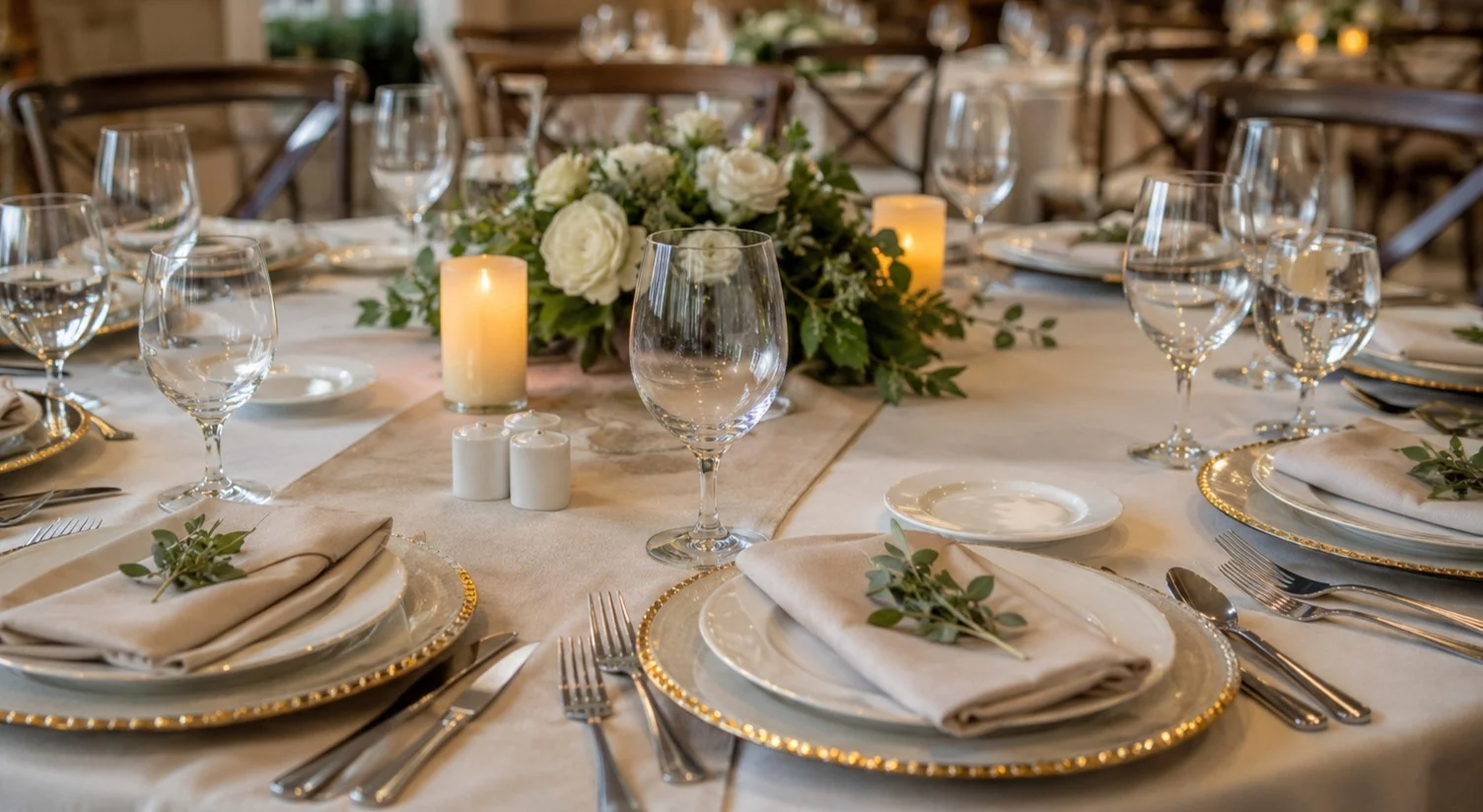
How to properly set the table: arranging plates, cutlery and glasses, choosing textiles, decor, lighting and practical tips for a banquet.
Before arranging plates and cutlery, check the basic elements:
A clean tablecloth or table runner
A sufficient number of charger plates and dinner plates
Polished glassware
Napkins
Spare cutlery
Create a preparation schedule:
When to place the table linens
When to polish the glassware
When to arrange the centrepieces
This will save time during the final preparation. Before setting the table, make a test arrangement on the actual table to assess the distances and service routes.
Do not forget the spare items:
Additional napkins
Napkin rings
Adhesive place labels
Transparent candle holders
For events held in limited spaces, allow 40–60 cm of seating width per guest and leave at least 30 cm between the edge of the table and the cutlery to provide comfortable access for the waiter or host.
Include safety checks in your checklist:
Stability of decorative arrangements
Absence of flowers that may cause allergic reactions
When considering how to set a table correctly, start with a simple sequence.
Here is the basic table-setting arrangement:
Place the charger plate first.
Put the dinner plate on top of it.
Place the forks to the left of the plate.
Place the knives to the right, with the blades facing the plate.
Place the spoons to the right of the knives.
Put the napkin on the plate or to the left in a cutlery pocket, depending on the event format.
Glassware arrangement:
Place the water glass slightly above the upper-right corner of the plate.
Place the white wine glass to the right and slightly lower.
Place the red wine glass farther to the right and slightly higher.
For a multi-course menu, place the dessert cutlery above the plate or bring it out when the dessert is served.
Finish by marking the seats and preparing brief instructions for the service staff to prevent confusion during serving.
The choice of table linens depends on the event format:
For everyday events, choose durable and easy-to-wash cotton or linen fabrics.
For formal occasions, use heavier fabrics with an elegant hanging edge.
The tablecloth drop should suit the event:
A drop of 20–30 cm is suitable for everyday use.
A drop of 30–40 cm creates a more festive appearance.
A charger plate adds another layer and a colour accent. Use a neutral base with bright napkins or table runners.
Caring for tableware and glassware is simple but important:
Wash the tableware and glassware.
Polish them with lint-free cloths.
Check that there are no stains or streaks.
For events with a limited budget, choose reusable fabric napkin rings and seasonal low centrepieces. They improve the appearance of the table without unnecessary expense.
When coordination of many tables or logistical support is required, LeOla Catering has experience in comprehensive event preparation and can assist with planning table settings for different event formats.
Quick napkin-folding methods create an immediate visual effect without requiring much additional time.
PLEATED FAN
Fold the napkin in half, make several accordion folds, lift it and open it on the plate. This option looks festive and saves preparation time.
CUTLERY POCKET
Fold the napkin in half, fold the sides towards the centre and insert the cutlery. This is a practical and tidy option.
NAPKIN ROLL WITH A RING
Roll the napkin tightly and secure it with a reusable ring or a piece of string. This option works well for casual events.
Decorations should be simple and reusable:
A small sprig of rosemary or eucalyptus
Dried flowers
A cardboard place card with the guest’s name
A fabric ribbon
These elements add personality without overcrowding the table.
Choose reusable fabric or metal napkin rings. After the event, clean the napkins and store them in boxes so they can be prepared quickly for the next occasion.
The main rule is that decorations must not interfere with conversation.
For most events, choose:
Low centrepieces up to 25–30 cm high
Long, narrow arrangements running along the centre of the table
When using tall centrepieces, alternate them with empty sections or place them only on large tables where guests can still see and hear one another.
Avoid strongly scented flowers and plants that may irritate guests or cause allergic reactions.
Candles or LED alternatives can be used for lighting.
Safe options include:
Electric candles
Small candles in stable holders
Wax candles inside enclosed glass lanterns
Secure the base of each arrangement with a heavy vase or holder to prevent it from tipping over when waiters move around the table.
Remember the fire-safety rules: never place an open flame under curtains or near easily flammable materials.
The standard glassware arrangement is as follows:
Place the water glass closest to the right-hand side of the place setting.
Place the white wine glass to the right and slightly lower.
Place the red wine glass farther to the right and slightly higher.
When sparkling wine is served, place its glass between the water glass and the white wine glass or slightly in front of them.
Leave approximately 2–3 cm between the glasses so that guests do not knock them over while talking.
Table-setting layers:
The charger plate forms the first layer.
Place the dinner plate on top.
Add the soup or salad plate.
Place the bread plate at the upper-left side.
Put a small butter knife on the bread plate.
Plan the service route for drinks:
Serve water first.
Serve wine afterwards according to the menu.
Inform the waiter about the serving order.
Clearly identify the seats of guests with allergies.
When many tables are involved, mark the seats in advance and prepare instructions for the staff. In such cases, LeOla can assist with service coordination and organisation.
For a children’s table, choose durable and shatter-resistant tableware:
Silicone tableware
Melamine tableware
Thick glass for older children
Use simple napkins and bright placemats that remain securely in place.
Reduce the amount of decoration:
One small central decorative element
Several small accessories that do not present a choking hazard or risk of scattering
Serve portions in convenient containers or on individual trays. This reduces cleaning time and limits unnecessary movement around the table.
For guests with additional accessibility needs, reduce the height of the centrepieces and provide enough room for a wheelchair or other mobility aids.
Leave a free section of the table or prepare a separate place.
Additional recommendations:
Use contrasting plates and napkins for guests with visual impairments.
Ensure that cutlery is easy to reach for guests with limited mobility.
Mark allergens at each relevant place setting.
In a limited space, use individual placemats instead of a full tablecloth, choose long and narrow centrepieces and alternate decorated sections with empty areas. This prevents the table from becoming overcrowded and makes service easier.
Cost-effective solutions can create a festive appearance without significant expense:
A neutral base with white or pastel table linens
Bright napkins
Reusable fabric napkin rings
Seasonal local flowers in small vases
Groups of inexpensive candles
LED lighting
Renting charger plates, table linens and decorations is often cheaper than buying them, especially for a one-time event.
Plan everything in advance and prepare a checklist:
Which items need to be washed
Which items need to be polished
How many spare items are required
Who is responsible for transportation
Professional assistance is recommended when:
There are many tables
Preparation time is limited
Coordination between the kitchen and florist is required
There are specific accessibility requirements
Additional safety measures are needed
LeOla has experience in table-setting logistics and can assist with organising the mise en place, marking seats and preparing instructions for staff. This is useful when fast and reliable coordination is needed without placing additional responsibilities on the event host.
Follow the traditional arrangement:
Forks are placed on the left.
Knives are placed on the right, with the blades facing the plate.
Spoons are placed to the right of the knives.
The charger plate forms the first layer.
The dinner plate and soup plate are placed on top.
Leave at least 30 cm between the edge of the table and the cutlery and allow 40–60 cm of space for each guest. Prepare spare cutlery and polishing supplies the day before the event.
Follow this sequence:
Place the charger plate.
Add the main dinner plate.
Put the napkin on the plate or to the left in a cutlery pocket.
Arrange the forks in the order of use, working from the outside towards the plate.
Place the knives and spoons on the right.
Position the water glass above the knife.
Place the wine glasses to the right.
Position the dessert cutlery above the plate.
After arranging everything, step back and check the overall appearance and symmetry.
Plan the timing and create a test arrangement on the actual table.
You should also:
Mark the seats
Coordinate the serving order with the kitchen
Identify allergens
Choose low centrepieces that allow easy conversation
Prepare service routes
Prepare spare items
Charger plates and table linens can be rented to create a consistent appearance. Proper preparation will also help prevent delays during serving.
Use individual placemats instead of a full tablecloth or choose a narrow table runner to make the surface appear less crowded.
Additional recommendations:
Alternate low centrepieces with empty sections.
Use compact charger plates.
Minimise unnecessary accessories.
Leave at least 30 cm from the edge of the table for service.
Maintain clear routes for the waiters.
This will make serving faster and safer.
A quick festive effect can be created with:
A neutral tablecloth
A bright napkin
Polished tableware
LED candles
Seasonal low flowers
Before serving, complete the final table setting:
Polish the glasses.
Mark the seats.
Check the service route.
When there are many guests, the menu is complicated or preparation time is limited, contact LeOla, a catering service in Lviv: https://leola.com.ua/
The team can assist with menu preparation and event logistics.


LEAVE A REQUEST
Food consultants are here to help!